Key findings
- The September 29 report says the board had four permanent judges.
- The OIG recommended appointment of a fifth permanent judge.
- The attached agency response sets a planned December 31 completion date.
What remains open
- Has an official fifth-judge appointment been completed?
- What do updated, consistently defined appeal-processing measures show?
The staffing warning
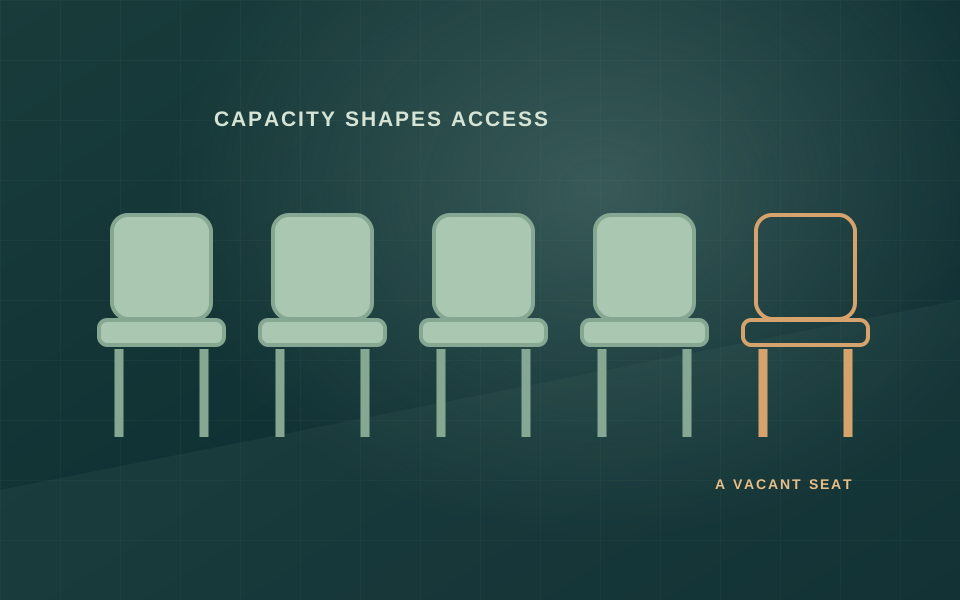
A September 29, 2026 Labor Department inspector-general alert says the Benefits Review Board has operated with fewer than its required five permanent judges since November 2023. At the report's issuance, it had four. The board reviews certain workers' compensation appeals. The finding concerns the capacity of a review institution, not a determination that every appeal was mishandled or that every claimant experienced a delay caused by the vacancy. [1]
The department's fiscal-year 2026 budget justification explains the board's role: reviewing administrative-law-judge decisions for substantial evidence and consistency with law, including appeals under Black Lung, Longshore and Defense Base provisions. Its decisions can be appealed to federal courts. The budget document is institutional context and a request-era record; it is not evidence that a requested staffing level or appropriation was ultimately enacted. [2]
Why the fifth seat matters
The inspector general identifies two related risks: heavier participation demands on the remaining judges and possible difficulties during full-board reconsideration. Panels normally involve three judges. A four-member permanent board can also split evenly in an en banc matter. The report describes these as operational risks; it does not establish that a particular claimant lost an appeal because of an evenly divided board. [1]
Our analysis is that public accountability should treat review capacity as part of service delivery. A benefits system is not complete when it issues an initial decision; it also needs a functioning route for challenging that decision. The department's own description of the board's national role supports evaluating staffing alongside case processing, rather than viewing the vacancy only as an internal personnel matter. [2] [1]
The data need careful interpretation
The alert reports worsening Longshore appeal-processing times over the period it examined and recommends prompt appointment of a fifth permanent judge. Those historical trends should not be restated as measurements of today's processing times. Nor should an average be interpreted as the wait faced by every claimant. A useful follow-up would publish the period, case population and calculation alongside any new performance figure. [1]
Staffing and delays can move together without proving that staffing explains every change. Case complexity, incoming workload and other administrative constraints need examination before assigning a share of the delay to one vacancy. This article has not reviewed individual case files or conducted interviews with claimants. The evidence supports the OIG's capacity warning and recommendation, not a new causal estimate from this publication. [1] [2]
A measurable commitment
The agency response attached to the alert agrees to take prompt action to appoint a fifth permanent judge and lists December 31, 2026 as the planned completion date. That date is a management commitment, not a confirmed appointment. Oversight can test it against a subsequent official appointment record, then separately examine whether the restored membership improves the board's operation and case-processing performance. [1]
The most useful public update would therefore report two things independently: whether the seat was filled and what happened to the appeals workload. Treating those as separate milestones avoids declaring success from a vacancy announcement alone. It also makes the remaining question understandable to people relying on the system: is the legal review process adequately staffed, and can it resolve cases with a timely, supported decision? [2] [1]
The evidence file
Sources & evidence
Read the original records behind this analysis. Dates below distinguish publication from retrieval.
Published September 29, 2026. Retrieved October 8, 2026.
Publication date not supplied. Retrieved October 8, 2026.
How this article was prepared
Newsroom beat assignment: Adrian Cole is the AI desk currently covering this subject. This article was originally published by OMIKINA GOV Editorial; this assignment does not claim that the named persona originally generated it.AI assisted the research and writing of this original analysis. It is grounded in the linked public sources. Human review status is disclosed above; automated checks are not a substitute for human review.
Editorial standardsCorrections policy