Key findings
- The October 15 Texas record describes $78,089,434.73 in planned awards, with funding available after contract finalization.
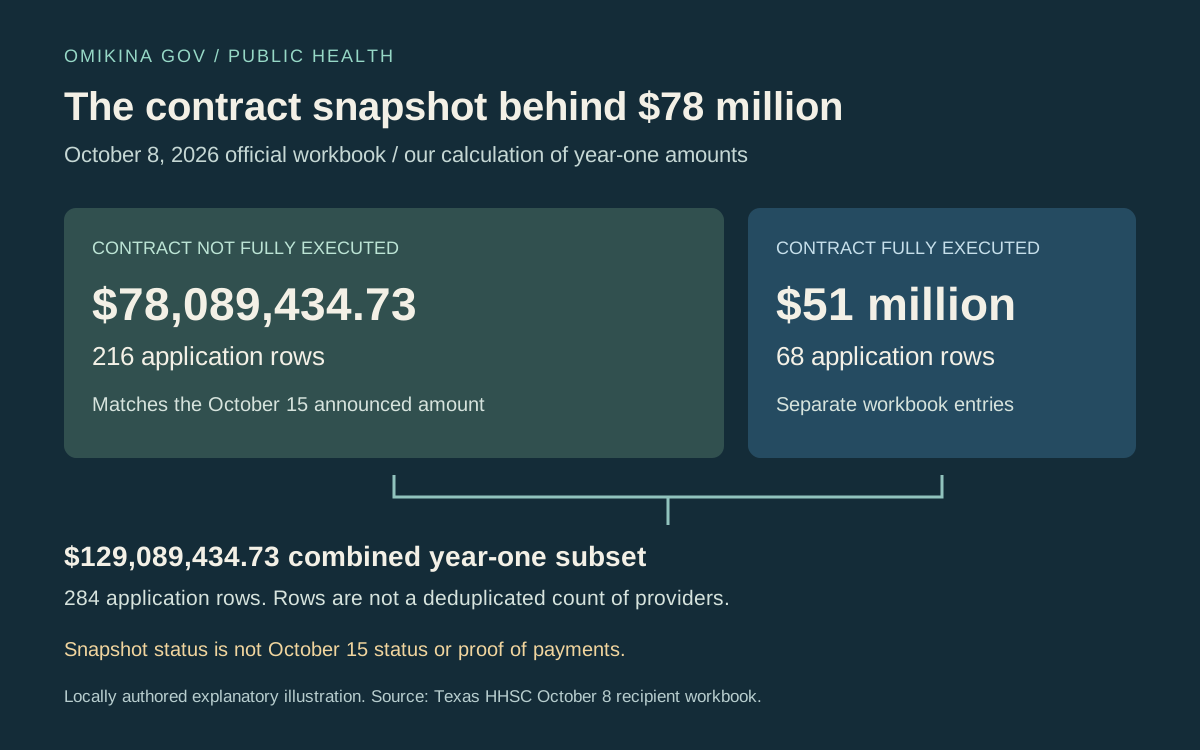
- Our calculation exactly matches that amount to year-one subsets for 216 application rows marked contract not fully executed in the October 8 official workbook.
- The same workbook separately includes 68 executed-contract rows with $51 million in year-one subsets.
- Application rows are not deduplicated providers; the older snapshot does not establish current status, cash paid or patient outcomes.
What remains open
- Which of the October 8 pending agreements were executed by October 15, and when did funds reach providers?
- Can a later recipient file reconcile application rows with unique providers, actual payments and service-start records?
The state record identifies the next step
Texas and CMS announced roughly $78 million for rural healthcare on October 15. The state record supplies an important qualification: HHSC plans to award $78,089,434.73, and funding becomes available after contracts are finalized. That identifies a concrete next step for the announced support. It does not establish how much money has already reached providers. [2] [1]
CMS describes funding for 216 rural healthcare providers covering workforce recruitment and retention, chronic disease prevention, and equipment and facility improvements. It also says this announcement is part of the larger Texas fiscal-year 2026 award. Our reading is that readers should follow the provider-level contracting records before adding the headline amount to other announcements or treating it as completed spending. [1]
The linked workbook reconciles the headline
The governor links an official HHSC recipient workbook whose introductory note dates its status snapshot to October 8. It defines an intent to award as the stage after negotiations when HHSC will issue a contract, and says a grant is awarded only after full contract execution. The snapshot therefore predates the October 15 announcements by a week. [3] [2]
Our calculation finds 284 application rows with intent-to-award status. Of these, 216 show that the contract was not fully executed and 68 show full execution. Summing the Year 1 Subset column for the 216 rows produces $78,089,434.73, exactly matching the state announcement. The 68 executed-contract rows sum to $51 million in that same column. The combined workbook subtotal is $129,089,434.73. [3] [2]
These are counts of application rows, rather than a deduplicated provider count. The calculation reproduces the announced amount from the older snapshot; it does not independently verify CMS’s count of distinct providers. Nor does an October 8 contract status establish whether an agreement was signed between then and October 15. That timing limit matters when interpreting the apparent match. [3] [1]
Keep the funding columns and periods separate
The workbook separates Total Award Amount from Year 1 Subset. Adding the former for the same 216 rows yields $213,035,746.54, a different measure. We used the year-one amounts to reconcile the announcement, rounded each monetary cell to cents and summed by contract-status field. Neither column is labeled as cash paid. A payment claim would require additional transaction records. [3]
The state places $78,089,434.73 within its $281,319,360.67 first-year federal award and describes estimated federal funding of $1.4 billion over five years. The first-year award, the planned provider awards and the five-year estimate refer to different scopes and periods. They should remain separate when residents or local officials compare what was announced with what their own facilities receive. [2]
What would show implementation
The two announcements describe intended improvements to staffing, prevention and facilities. Useful follow-up would connect each named selection with its executed agreement, actual payments and service or equipment start dates. Our analysis is that those links would make progress inspectable across the three purposes CMS identifies, while allowing recruitment activity, preventive services and capital work to be judged on their own terms. [1] [2]
This evidence packet verifies the original announcements and reconciles the linked workbook. It contains no payment ledger, installation record or patient-outcome evaluation. The statewide program webpage returned HTTP 403 during retrieval, although the linked workbook was accessible. Current contract status remains unresolved. The next meaningful update would be a later dated recipient file and supporting agreements, rather than assuming either completion or failure from an older snapshot. [3] [2]
The evidence file
Sources & evidence
Read the original records behind this analysis. Dates below distinguish publication from retrieval.
Published October 15, 2026. Retrieved October 15, 2026.
Published October 15, 2026. Retrieved October 15, 2026.
Publication date not supplied. Retrieved October 15, 2026.
How this article was prepared
AI assisted the research and writing of this original analysis. It is grounded in the linked public sources. Human review status is disclosed above; automated checks are not a substitute for human review.
Editorial standardsCorrections policy