Key findings
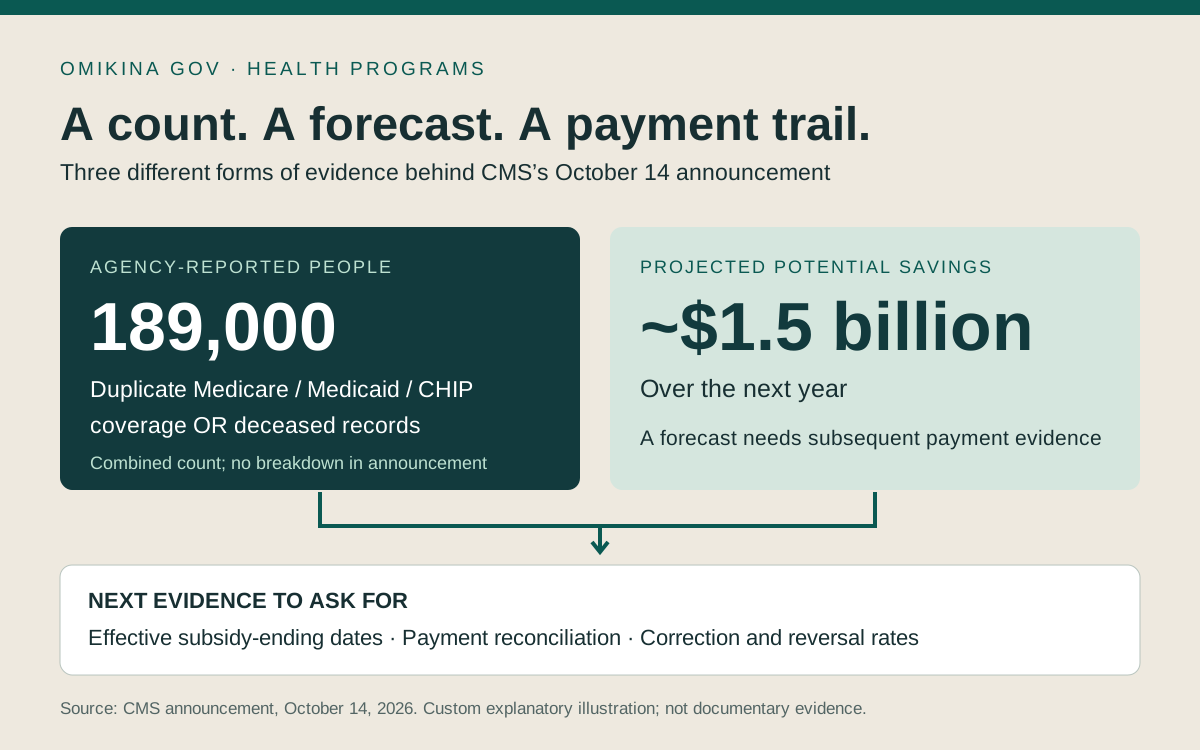
- CMS reports 189,000 people identified across duplicate government coverage and deceased records, and says it removed Marketplace subsidies.
- Approximately $1.5 billion is projected potential savings over the next year, not independently established realized savings.
- Matching procedures distinguish ending financial help, retaining full-cost coverage and ending coverage for deceased consumers.
What remains open
- How are the 189,000 cases divided across coverage programs and deceased records, and how is the savings forecast calculated?
- What payment reconciliation and correction or reversal rates support the reported removals?
A new count, a prospective estimate
CMS announced on October 14 that it identified 189,000 people in 2026 who had subsidized federal Marketplace coverage and either duplicate Medicare, Medicaid or Children’s Health Insurance Program coverage, or a record indicating they were deceased. The agency says it removed their Marketplace subsidies and projects approximately $1.5 billion in potential taxpayer savings over the next year. This is a newly reported agency action and forecast, not an independently measured total of payments recovered. [1]
The announcement combines several categories in one figure without publishing their separate counts or the calculation behind the savings estimate. It does not establish how much was previously paid incorrectly, how many decisions were later reversed, or whether a particular person committed fraud. The next accountability step is a reconciliation of affected records, effective subsidy-ending dates and subsequent payments. Repeating the forecast as money already saved would erase that missing evidence. [1]
Financial help and insurance are different decisions
CMS’s public data-matching directory distinguishes three processes: Medicaid/CHIP, Medicare and death checks. For Medicaid/CHIP, the relevant overlap is subsidized Exchange coverage alongside qualifying government coverage. Its Medicare description also separates ending financial help from ending a private plan with the consumer’s written consent. Death matching concerns ending coverage for deceased consumers. A single enrollment headline can therefore encompass different administrative actions, with different consequences for the household. [2]
The July 14, 2025 Medicaid/CHIP FAQ adds an important eligibility boundary: most Medicaid counts as qualifying coverage, but some limited-benefit coverage, such as emergency-only or family-planning coverage, does not. It also says that ending advance premium tax credits and cost-sharing reductions generally leaves the consumer enrolled in the Exchange plan at full cost unless they end that plan. The reported subsidy removals should not be described as 189,000 identical insurance cancellations. [3]
The response window is part of the control
The 2025 FAQ describes an initial warning, a resolution notice and a final warning. It says the Marketplace rechecks Medicaid/CHIP enrollment before ending financial help and directs consumers who believe a decision was incorrect to appeal instructions in their eligibility notice. These safeguards make record accuracy part of program integrity. Oversight should ask how often disputed matches were corrected and whether notices reached the people affected, rather than treating every initial data match as conclusive. [3]
CMS’s directory also publishes Medicaid/CHIP initial, resolution and final notice templates labeled August 2026, plus separate Medicare and estate-notice materials. That visible separation is useful: it gives readers a place to inspect which process a notice belongs to. The directory describes policy and available documents; it does not independently demonstrate that every notice in the October announcement was delivered or that each individual determination was correct. [2]
The earlier record gives the restart context
An August 12, 2024 CMS FAQ documented a notice-only Medicaid/CHIP matching process for that coverage year. It said the Exchange would send one warning but would not send a final notice or end financial assistance through that process, and anticipated resuming terminations in 2025. It connected the temporary pause to potentially inaccurate Medicaid/CHIP data and consumer harm during the return to routine eligibility reviews. This dated explanation is more specific than a broad political characterization of agency inaction. [4]
The same historical FAQ described work with states to improve real-time information and incorporate another data source into the matching process. That account does not prove current matching accuracy; it establishes the problem the operational changes were intended to address. A useful follow-up would publish reversal rates, the reasons for corrections and coverage transitions alongside financial results. Together, those measures would test whether the process prevents inappropriate subsidies while avoiding errors against people whose qualifying coverage has already ended. [4]
The evidence file
Sources & evidence
Read the original records behind this analysis. Dates below distinguish publication from retrieval.
Published October 14, 2026. Retrieved October 14, 2026.
Page last modified August 7, 2026. Retrieved October 14, 2026.
Published July 14, 2025. Retrieved October 14, 2026.
Published August 12, 2024. Retrieved October 14, 2026.
How this article was prepared
AI assisted the research and writing of this original analysis. It is grounded in the linked public sources. Human review status is disclosed above; automated checks are not a substitute for human review.
Editorial standardsCorrections policy