Key findings
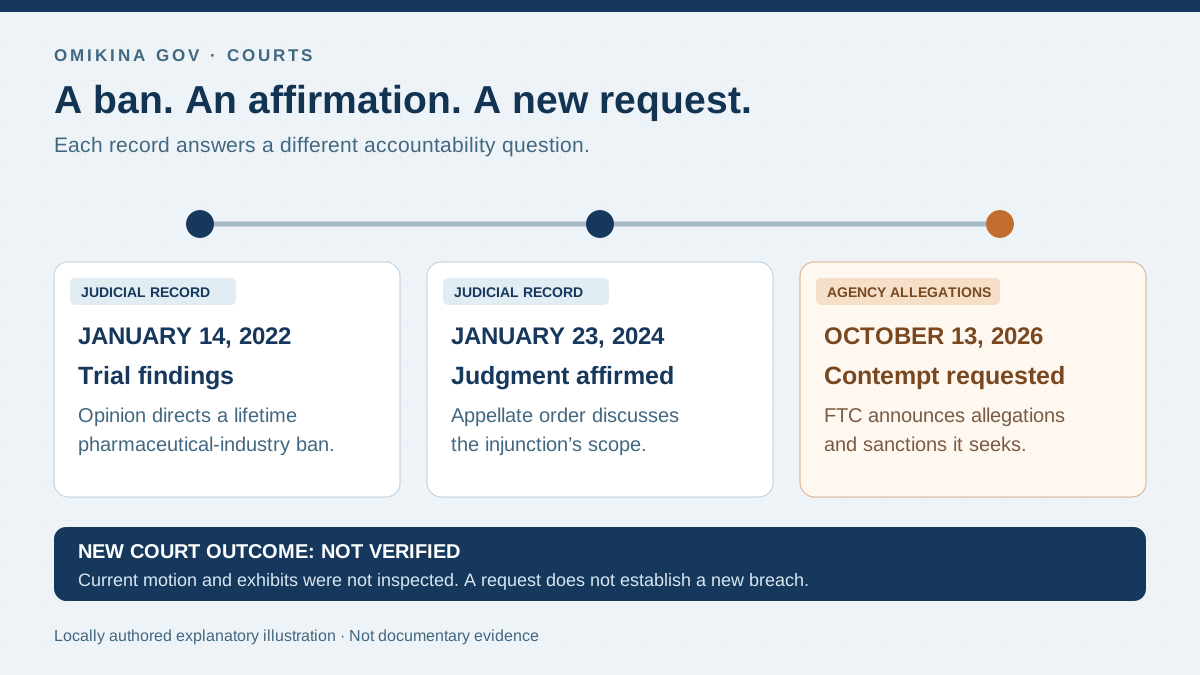
- The verified new event is the FTC’s October 13 announcement of a civil-contempt request, not a verified contempt ruling.
- Original 2022 trial and 2024 appellate records establish the historical ban; appellate text qualifies public-statement treatment.
- Today’s motion and exhibits were not linked in the retrieved latest FTC case timeline and were not independently inspected.
What remains open
- What evidence does the current motion supply, and what response will address it?
- How will the court apply the injunction to the alleged acts and assess the requested remedies?
A request for enforcement, not a new finding
The Federal Trade Commission says it and seven states asked the Southern District of New York on October 13 to hold Martin Shkreli in civil contempt. Their allegations concern pharmaceutical-stock trading and online efforts to influence pharmaceutical businesses after his 2022 industry ban. The verified new development is the agency’s announced enforcement request. The records reviewed for this article do not establish a court decision accepting those allegations. [1] [2]
Commissioner Mark R. Meador’s separately dated statement supports contempt sanctions and argues that the injunction requires enforcement. That is the position of a commissioner supporting the action, not an independent adjudication. Reading the agency’s announcement alongside his statement helps identify what the government wants the court to do, while preserving the distinction between an enforcement argument and a judicial conclusion. [3]
What the older court records actually establish
The January 14, 2022 district-court opinion followed a seven-day bench trial. It found antitrust violations involving restrictions on generic competition for Daraprim and directed a lifetime pharmaceutical-industry ban. Its remedy discussion connected the ban to preventing recurrence, rather than limiting it to operating one particular company. Those are historical judicial findings, distinct from the alleged conduct described in today’s announcement. [4]
The Second Circuit’s January 23, 2024 summary order affirmed the February 4, 2022 judgment. It upheld the lifetime ban and discussed a qualification for public statements: a statement about a pharmaceutical company is treated as influencing its management or business when Shkreli intended that effect or a reasonable person would conclude it had that effect. That wording matters when evaluating an allegation involving online commentary. [5]
Requested sanctions still require a court response
According to the FTC announcement, the plaintiffs seek divestiture of pharmaceutical stocks, a fine based on trading profits plus prejudgment interest without offsetting losses, and escalating consequences for future violations, potentially including incarceration. These are requested remedies. The announcement does not supply a judicially determined trading-profit figure or a new sanctions award, and this article does not characterize any of them as already imposed. [1]
Our analysis is that the useful accountability question has two parts: whether the alleged acts fall within the injunction’s actual terms, and what response the court orders if it finds a violation. The appellate discussion makes the first question more precise than simply asking whether a video mentioned a drug company. The agency’s requested sanctions identify the second question; they do not answer it. [5] [1]
The evidence gap remains visible
At retrieval, the FTC case page’s October 13 timeline entry linked the announcement and commissioner statement, but no current motion or brief. We therefore verified the agency’s original announcement and the older court records without independently inspecting today’s court filing, its exhibits, a defense response or a new judicial order. Earlier contempt documents on that page must not be mistaken for this request merely because they concern the same defendant. [2] [1]
The next meaningful record would show the current motion’s evidence, any response and the court’s treatment of the alleged acts and requested sanctions. Until those are verified, the public can identify an enforcement action and an existing judicial restriction, but not a newly established breach. Keeping those stages separate allows later reporting to describe an actual ruling without silently turning the government’s opening position into the outcome. [2] [1] [5]
The evidence file
Sources & evidence
Read the original records behind this analysis. Dates below distinguish publication from retrieval.
Published October 13, 2026. Retrieved October 13, 2026.
Published October 13, 2026. Retrieved October 13, 2026.
Published October 13, 2026. Retrieved October 13, 2026.
Published January 14, 2022. Retrieved October 13, 2026.
Published January 23, 2024. Retrieved October 13, 2026.
How this article was prepared
AI assisted the research and writing of this original analysis. It is grounded in the linked public sources. Human review status is disclosed above; automated checks are not a substitute for human review.
Editorial standardsCorrections policy