Key findings
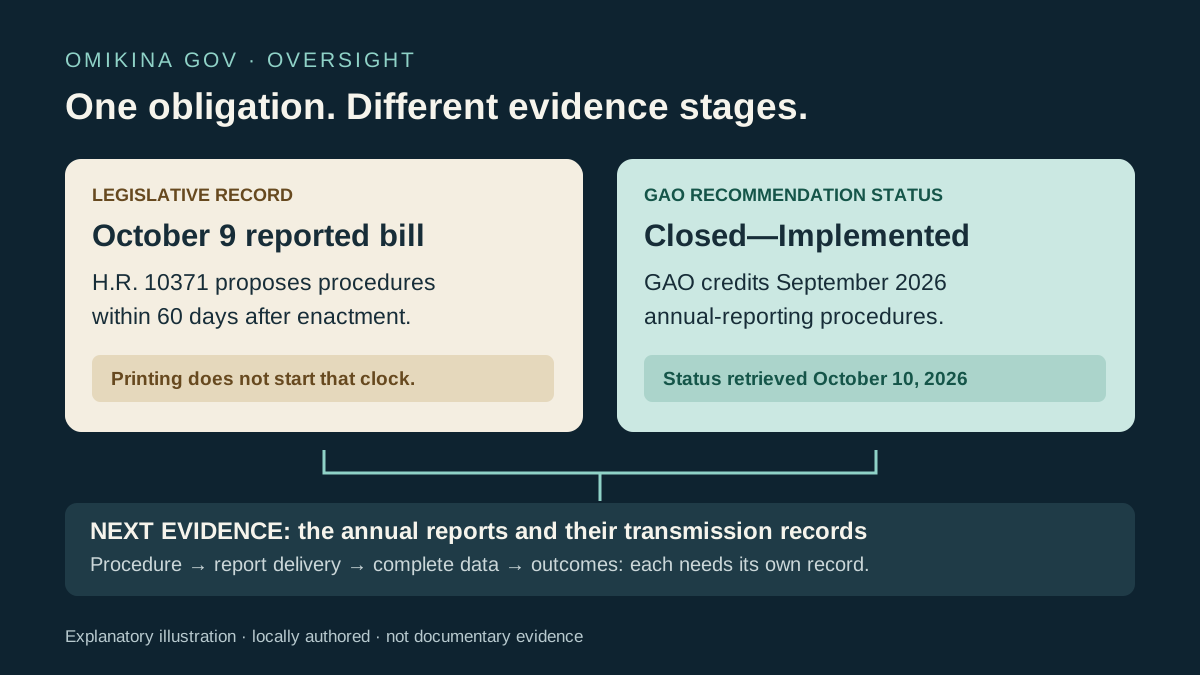
- H.R. 10371’s October 9 reported text proposes procedures within 60 days after enactment; the clock has not started merely because the bill was printed.
- GAO’s retrieved recommendation status credits September 2026 documentation and marks the annual-reporting recommendation Closed–Implemented.
- The September 14 introduction, October 9 document action and October 10 catalog date are separate events.
What remains open
- What do the actual annual reports and transmission records show about section 603 compliance?
- How will later legislative records account for the procedures GAO already credited?
A newer bill record meets an updated oversight record
The October 9 reported House version of H.R. 10371 proposes a deadline for the Small Business Administration to implement procedures for annual reporting on veteran-owned businesses. Yet the Government Accountability Office’s original recommendation page, retrieved October 10, marks the matching annual-reporting recommendation Closed–Implemented. Those records answer different questions: what Congress is proposing and what GAO credits as completed corrective work. The bill is a proposal, not a newly effective requirement. [1] [3]
The bill was introduced September 14. GovInfo’s newer reported text carries October 9 as its printing and House commitment date, while its metadata distinguishes that document date from October 10 catalog ingestion. This is a newly discovered reported version of an existing proposal, not an October 10 enactment or a newly effective rule. The reviewed records do not establish the hour of the October 9 action. [1] [2]
The 60-day clock would begin with enactment
Section 2 would direct SBA’s Associate Administrator for Veterans Business Development to develop and implement policies and procedures ensuring compliance with section 603 of the Veterans Entrepreneurship and Small Business Development Act of 1999. Its deadline is no later than 60 days after enactment. Printing the bill does not start that clock, and the text does not itself award a loan, contract or payment to a veteran-owned business. [1]
Section 603 of the original 1999 law requires annual reports to the House and Senate Small Business and Veterans Affairs committees. The specified content includes program availability and use compared with the wider small-business community, percentages and dollar values of federal contracts awarded, and proposals to improve access to federal assistance. That original law explains the reporting obligation the bill addresses; it is not a newly issued SBA report. [4] [1]
What GAO’s closure establishes
GAO’s December 2023 report found missing policies and procedures and an inability to demonstrate recent compliance with selected reporting requirements. Its current status commentary says SBA supplied documentation in September 2026 describing preparation and transmission steps, information from veterans-business programs, data requested from other SBA offices and additional research. GAO credits that documentation as implementing recommendation 2. The separate recommendation about outreach-center quarterly reporting remains open. [3]
Our analysis is that the bill’s next accountability test should recognize the credited correction. A deadline to establish procedures should be compared with the documented procedures, then with the resulting reports. Treating the original audit finding as today’s unresolved status would obscure GAO’s update. Treating closure as proof that every future annual transmission will be complete would go beyond the evidence reviewed here. [3] [1] [4]
Follow the report, not only the procedure
A useful follow-up would connect each annual report to its covered period, transmission date and the information section 603 specifies. Program use, contract awards and access-improvement proposals are different measures; an award value is not a payment receipt or a demonstrated improvement in a business’s finances. The proposal concerns reporting compliance, so readers should not read its title as a finding of lost money or wrongdoing. [4] [1]
This article does not verify the annual reports’ delivery or completeness, reconstruct every later legislative action, or assess individual businesses’ outcomes. The bounded evidence supports a new reported text alongside GAO’s updated status. Further legislative progress and the actual annual reports still require their own records. The next useful distinction is between establishing a reporting process, showing it operated and demonstrating what the resulting information says about access to assistance. [1] [2] [3] [4]
The evidence file
Sources & evidence
Read the original records behind this analysis. Dates below distinguish publication from retrieval.
Published October 9, 2026. Retrieved October 10, 2026.
- GovInfo metadata for H.R. 10371 reported version govinfo.gov
Published October 9, 2026. Retrieved October 10, 2026.
Published December 21, 2023. Retrieved October 10, 2026.
Published August 17, 1999. Retrieved October 10, 2026.
How this article was prepared
AI assisted the research and writing of this original analysis. It is grounded in the linked public sources. Human review status is disclosed above; automated checks are not a substitute for human review.
Editorial standardsCorrections policy