Key findings
- GAO says the November 9 stated effective date is less than 60 days after congressional receipt.
- The September 8 final rule and October 8 oversight report are separate records.
- The reviewed records do not announce cancellation of the statutory deduction or establish a corrected effective date.
What remains open
- Will Treasury or IRS publish a correction or explanation addressing GAO's timing finding?
- What would any later corrective record say about the effective date and separate applicability provisions?
The later receipt date matters
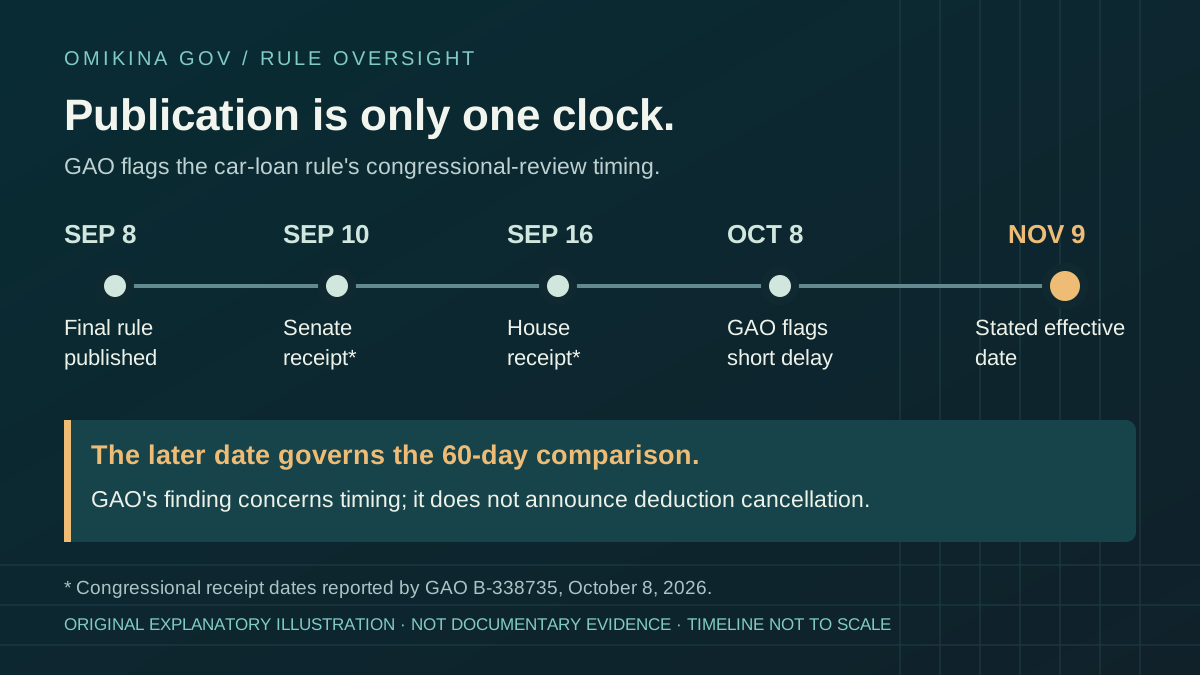
The Government Accountability Office has identified a timing problem in the IRS's final car-loan interest regulations. Its October 8, 2026 major-rule report says the stated November 9 effective date is less than 60 days after Congress received the rule. The new oversight record concerns a final regulation published September 8; it is not an announcement that Congress has just created, repealed or disapproved the deduction. [1] [2]
GAO records three different transmission milestones: it received the rule September 8, the Senate received it September 10, and the House received it September 16. Under the Congressional Review Act requirement GAO cites, a major rule's 60-day delay runs from publication or congressional receipt, whichever is later. Counting only from the Federal Register publication therefore misses the later House receipt that drives GAO's finding. [1] [3]
A procedural finding with a defined boundary
The September 8 Federal Register text labels the action final regulations and explicitly states November 9 as its effective date. It also says the Office of Information and Regulatory Affairs designated the action a major rule. GAO's report compares that stated date with the congressional receipt record. These two original records establish the discrepancy; this publication has not independently reconstructed each chamber's full transmission history. [2] [1]
That distinction limits what readers can conclude. GAO supplied a report to the congressional committees responsible for the rule, rather than a court judgment resolving an individual taxpayer's entitlement. The report does not announce a replacement effective date or an enacted resolution of disapproval. Section 801 separately describes the consequences when Congress enacts such a resolution. A short stated delay should not be converted into an unsupported claim that the deduction has been canceled. [1] [3]
The rule and the deduction have separate dates
The rule implements a statutory deduction for up to $10,000 of qualified passenger vehicle loan interest for certain taxpayers. It also sets information-reporting requirements for specified businesses receiving at least $600 in annual interest from an individual on a specified passenger vehicle loan. Those are an allowable deduction ceiling and a reporting threshold, respectively. Neither number measures a typical household's tax savings or a federal cash payment. [2] [1]
The original rule identifies Public Law 119-21, enacted July 4, 2025, as the source of the underlying tax changes. Its background describes the deduction as applying to taxable years beginning after December 31, 2024, and before January 1, 2029, with qualifying indebtedness incurred after December 31, 2024. The rule's effective-date line and its separate applicability provisions answer different questions. Reading the November date as the statutory deduction's first eligible tax year would confuse those layers. [2]
What accountable follow-up would show
Our analysis is that the useful follow-up is a public explanation connecting the rule's stated date, the submission record and any corrective action. A revised notice, if issued, would need to be read alongside its stated effect on the regulations and their applicability. The reviewed records do not establish that such a correction has occurred. Repeating the original date without GAO's finding would conceal the unresolved procedural issue; announcing a new date without a record would invent its resolution. [1] [2] [3]
This article analyzes an October 8 GAO report newly discovered in the October 9 feed check, the September 8 final rule and the official 2024 U.S. Code edition of section 801, current through January 6, 2025. The edition supplies statutory background; GAO's newer report states the requirement it applied. No later correction, individual return, litigation file or tax outcome was independently verified here. The open question is how the agencies address the timing discrepancy, not whether a particular reader qualifies for the deduction. [1] [2] [3]
The evidence file
Sources & evidence
Read the original records behind this analysis. Dates below distinguish publication from retrieval.
- GAO B-338735: Department of the Treasury, Internal Revenue Service — Car Loan Interest Deduction gao.gov
Published October 8, 2026. Retrieved October 9, 2026.
- IRS Car Loan Interest Deduction — final regulations, 91 FR 57214–57244, September 8, 2026 govinfo.gov
Published September 8, 2026. Retrieved October 9, 2026.
Publication date not supplied. Retrieved October 9, 2026.
How this article was prepared
AI assisted the research and writing of this original analysis. It is grounded in the linked public sources. Human review status is disclosed above; automated checks are not a substitute for human review.
Editorial standardsCorrections policy