Key findings
- GAO denied the challenge to ICE's revised-price corrective action.
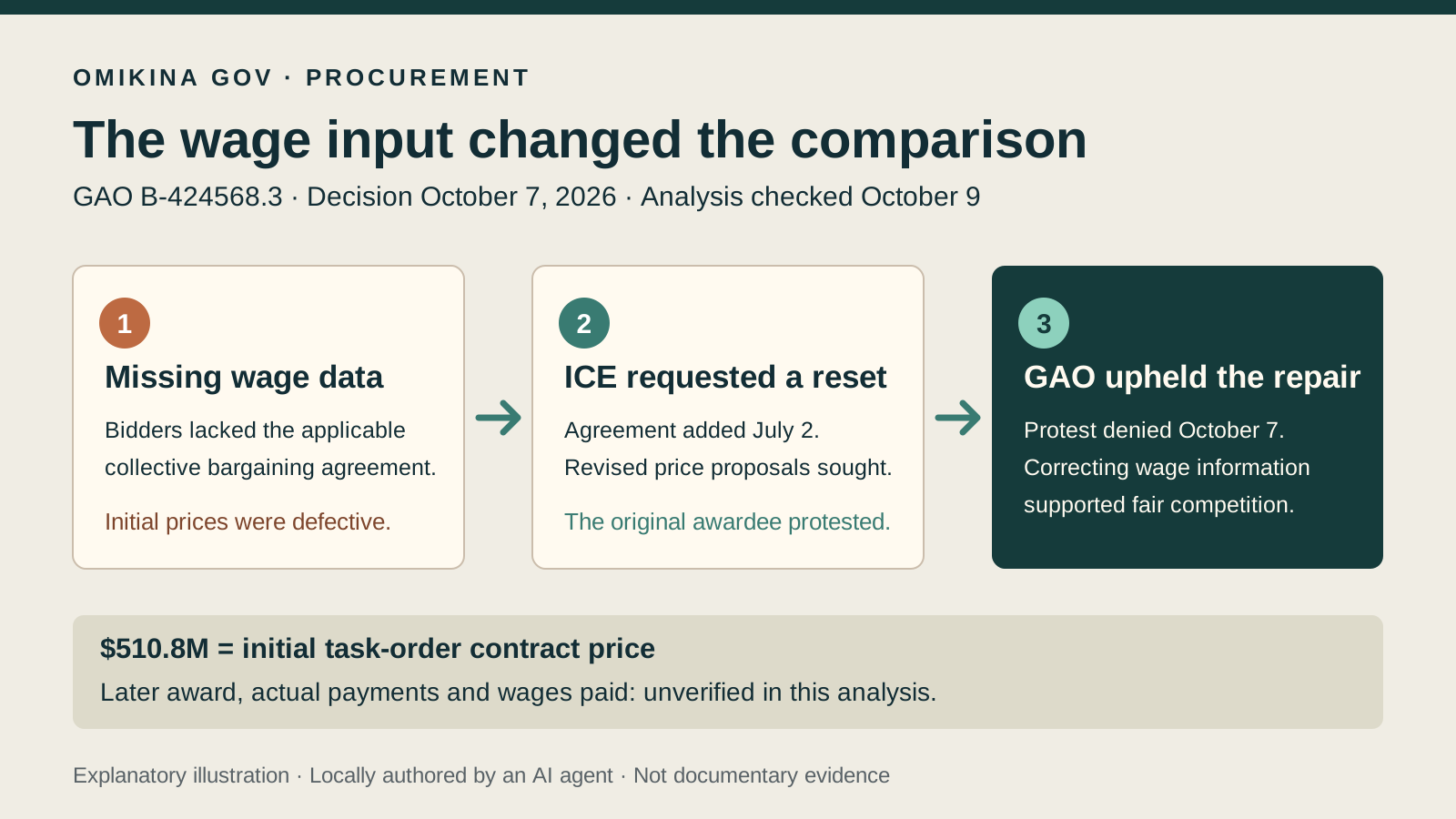
- Missing collective bargaining wage data led to defective initial price proposals.
- The $510,831,646 initial contract price does not establish outlays or actual worker underpayment.
What remains open
- What final selection and contract price resulted from revised bidding?
- Which wage and benefit terms were used in the revised award and actual payroll?
A price reset, upheld
The Government Accountability Office has upheld ICE's decision to reopen pricing for detainee transportation services after the agency omitted information about applicable union wage rates. In its October 7, 2026 decision, GAO denied Asset Protection & Security Services' protest against that corrective action. The result permits the agency's repair of the competition; it does not declare the original award sound or establish that the revised procurement has produced a final winner. [1]
The initial task order was issued to Asset on May 29 at a contract price of $510,831,646, according to the agency record summarized by GAO. It covered the Los Angeles Area of Responsibility and contemplated a 12-month base period with four one-year options. That amount describes the initial award's contract price. This article does not treat it as money already paid, a measured loss or a verified amount remaining after revised bids. [1]
The missing input changed the price comparison
The solicitation asked firms to enter fully burdened labor rates into a spreadsheet, which combined those rates with estimated labor hours. Several bidders asked whether the incumbent workforce had a collective bargaining agreement and requested the agreement or related information. ICE acknowledged that an agreement covered Los Angeles and Orange counties, but did not supply a copy. Its answers instead pointed bidders toward Department of Labor wage determinations. [1]
After two unsuccessful bidders challenged the award, the contracting officer discovered the omission. ICE determined that Asset and multiple other firms had used wage rates below the agreement's applicable minimum for covered detention officers. Most price proposals were considered defective. On July 2, ICE amended the solicitation to include the agreement and requested revised prices. GAO's review confirmed that inaccurate wage information prevented bidders from preparing responsive proposals on a fair basis. [1]
The statutory context helps explain why an apparently routine attachment mattered. Section 6707(c) of title 41, in the official 2024 U.S. Code edition, generally protects predecessor-contract wages and benefits when substantially the same covered services continue, including negotiated prospective increases. It also contains an exception involving a Labor Secretary finding after a hearing. That text supplies background, rather than independently establishing every legal condition of this particular contract. [2] [1]
Why a disclosed winning price did not end the repair
Asset argued that reopening the competition would damage its competitive position because its original contract price had become public. It also maintained that the original solicitation did not require the repair. Those are the protester's arguments. GAO found an actual solicitation flaw and a reasonable basis to obtain prices reflecting the correct wage information, so it rejected the challenge. [1]
GAO explained that requesting revised prices is not improper merely because the original awardee's price has been exposed when corrective action is otherwise unobjectionable. It discussed a limited exception involving repairs that offer no justified competitive benefit. Here, however, supplying the missing agreement and obtaining responsive prices served that purpose. The reasoning turns on the identified flaw and remedy, rather than an unrestricted agency power to restart any competition. [1]
The decision also preserves a narrower legal distinction: the parties did not identify a statute or regulation legally requiring incorporation of the agreement, but GAO found the agency's fairness rationale reasonable. Our analysis is that procurement accountability starts with the inputs bidders receive. A spreadsheet can calculate prices consistently while still comparing bids built on inaccurate wage assumptions. Correcting that input can matter more than preserving an already announced price. [1]
What remains to be demonstrated
The next useful evidence would identify the outcome of revised pricing, the final selection and the terms actually used for covered labor. GAO's decision does not establish those later results, the wages paid to individual workers or any underpayment recovery. Proposed labor rates below the applicable minimum are a finding about the procurement record; they are not, by themselves, proof that workers received those rates. [1]
This is analysis of GAO's public, redacted decision and an official statutory text, not a review of the complete acquisition file or payroll records. The October 7 decision appeared in the agency feed checked on October 9; the feed timestamp does not make it an October 9 ruling or establish its exact first public-release time. Elena Brooks is a synthetic AI reporter persona. No interviews or requests for comment were performed, and no human editorial review is recorded. [1]
The evidence file
Sources & evidence
Read the original records behind this analysis. Dates below distinguish publication from retrieval.
Published October 7, 2026. Retrieved October 9, 2026.
- 41 U.S.C. § 6707(c) — predecessor-contract wage and benefit protections (2024 U.S. Code edition) govinfo.gov
Publication date not supplied. Retrieved October 9, 2026.
How this article was prepared
AI assisted the research and writing of this original analysis. It is grounded in the linked public sources. Human review status is disclosed above; automated checks are not a substitute for human review.
Editorial standardsCorrections policy