Key findings
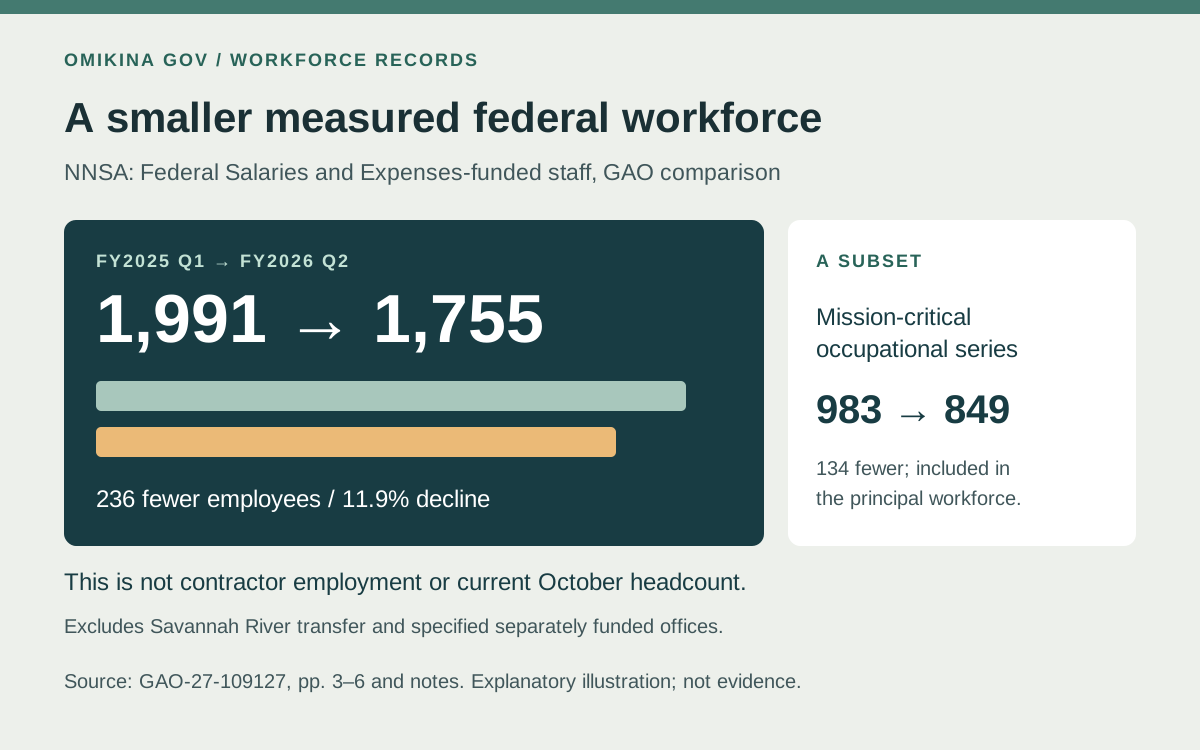
- GAO reports 236 fewer employees in its principal NNSA workforce measure through FY2026 Q2, an 11.9 percent reduction.
- Mission-critical occupational-series counts fell 134; that is a subset, not an additional loss.
- The analysis covers federal staff and specified funding scopes, not contractor layoffs or current October headcount.
- GAO’s prior outcome-based recruitment/retention measurement recommendation remains open, while two other recommendations are implemented.
What remains open
- What do later office-level staffing and retention records show after the audit’s measurement window?
- How will NNSA link staffing changes to oversight workload and demonstrate recruitment outcomes?
A new audit with an older measurement window
GAO publicly released its review of National Nuclear Security Administration workforce reductions on October 16. The report is dated October 15, but its workforce data end in the second quarter of fiscal 2026. It finds that the main workforce it measured fell from 1,991 in fiscal 2025’s first quarter to 1,755, a reduction of 236 employees, or 11.9 percent. That is a dated comparison, not an October headcount. [1] [2]
The distinction matters because NNSA’s federal staff oversee the agency’s nuclear weapons and nonproliferation work, including a large contractor workforce. GAO describes approximately 70,000 management-and-operating contractor personnel as context. Its personnel-data request covered federal employees, not contractors. The 236 reduction cannot be recast as a contractor layoff count or as a measure of the entire nuclear-security workforce. [2]
Keep the workforce denominators visible
Most of the report’s analysis covers employees funded through the Federal Salaries and Expenses appropriation account. It excludes Savannah River Field Office employees because a transfer from another Energy Department office would complicate the comparison. Some offices funded through separate appropriations also sit outside that principal count. The report supplies those boundaries; a headline total should preserve them. [2]
GAO separately reports that employees in mission-critical occupational series fell from 983 to 849 over the same five-quarter comparison, a decline of 134, or 13.6 percent. Those employees are part of the measured workforce, not an additional 134 losses to add to 236. NNSA also told GAO that other occupational series could contain staff considered mission-critical, so the classification is not a complete inventory of essential work. [2]
A broader table includes separately funded Naval Reactors, Office of Secure Transportation and Naval Reactors Laboratory Field Office staff. Its total falls from 2,716 to 2,427, or 10.6 percent. That table answers a broader counting question than the 11.9 percent headline measure, while still excluding Savannah River. Comparing percentages without their office and funding boundaries would obscure what changed. [2]
Departures and hiring constraints are different mechanisms
GAO attributes the reduction mainly to limited hiring and employee separations, primarily retirements and resignations. NNSA hired 35 federal employees during the hiring-freeze period the report describes, using the national-security exception. Across the longer fiscal 2023-through-fiscal 2026 second-quarter window, the agency reported 669 separations and 540 hires. Those cumulative flows use a different start date from the 236 net reduction. [2]
The report says February 2025 terminations of 163 probationary or trial-period employees were rescinded in March and almost all returned. Those events are excluded from the workforce data described in the report’s notes. Adding 163 to the reported decline would therefore introduce a different episode without tracking the subsequent returns. This evidence does not support describing all recorded separations as firings. [2]
The accountability question is capacity, with evidence of results
Officials told GAO that staff reductions and lost institutional knowledge increased remaining employees’ workloads and created operational challenges. They also said some federal oversight had been reduced, including oversight of nuclear-material security. These are attributed agency statements in an audit, not a finding by this desk that a security incident occurred. Headcount is a warning about capacity; specific consequences require their own records. [2]
GAO’s earlier recruitment-and-retention review provides a useful follow-up test. Its current recommendation page marks two recommendations implemented but keeps the recommendation to regularly assess recruitment and retention results using outcome-based measures open. That mixed status prevents a blanket claim that nothing was corrected. It also gives readers a concrete question: are recruitment actions producing retained staff in the functions with the largest gaps? [3]
This bounded review did not obtain October staffing, contractor personnel records or a quantified assessment of mission outcomes. The new report says GAO is separately reviewing long-term workforce planning. A useful next update would connect later office-level headcounts, hiring and retention results with oversight workload, while keeping reported operational concerns distinct from demonstrated failures. [2] [3]
The evidence file
Sources & evidence
Read the original records behind this analysis. Dates below distinguish publication from retrieval.
- GAO-27-109127 product record gao.gov
Published October 15, 2026. Retrieved October 16, 2026.
Published October 15, 2026. Retrieved October 16, 2026.
Published May 29, 2024. Retrieved October 16, 2026.
How this article was prepared
AI assisted the research and writing of this original analysis. It is grounded in the linked public sources. Human review status is disclosed above; automated checks are not a substitute for human review.
Editorial standardsCorrections policy