Key findings
- The report was dated September 15 and publicly released October 14; its deployment snapshots are not current-day counts.
- GAO identifies gaps in updated plans, results-oriented measures, activation assurance and operational guidance.
- DHS agreed with six of seven recommendations; all seven remained open on the retrieved GAO page.
What remains open
- What updated plans, operational guidance and results measures will support closure of each recommendation?
- Which additional activation safeguards can satisfy recording policy while addressing the privacy and operational risks DHS identifies?
The new event is public release
GAO publicly released its review of Customs and Border Protection and Immigration and Customs Enforcement body-worn camera programs on October 14. The underlying report is dated September 15, 2026. That distinction matters: the new public record describes an earlier audit, rather than establishing what every office is doing today. GAO found outdated program plans, missing results-oriented measures and gaps in controls and operational guidance. [1] [2]
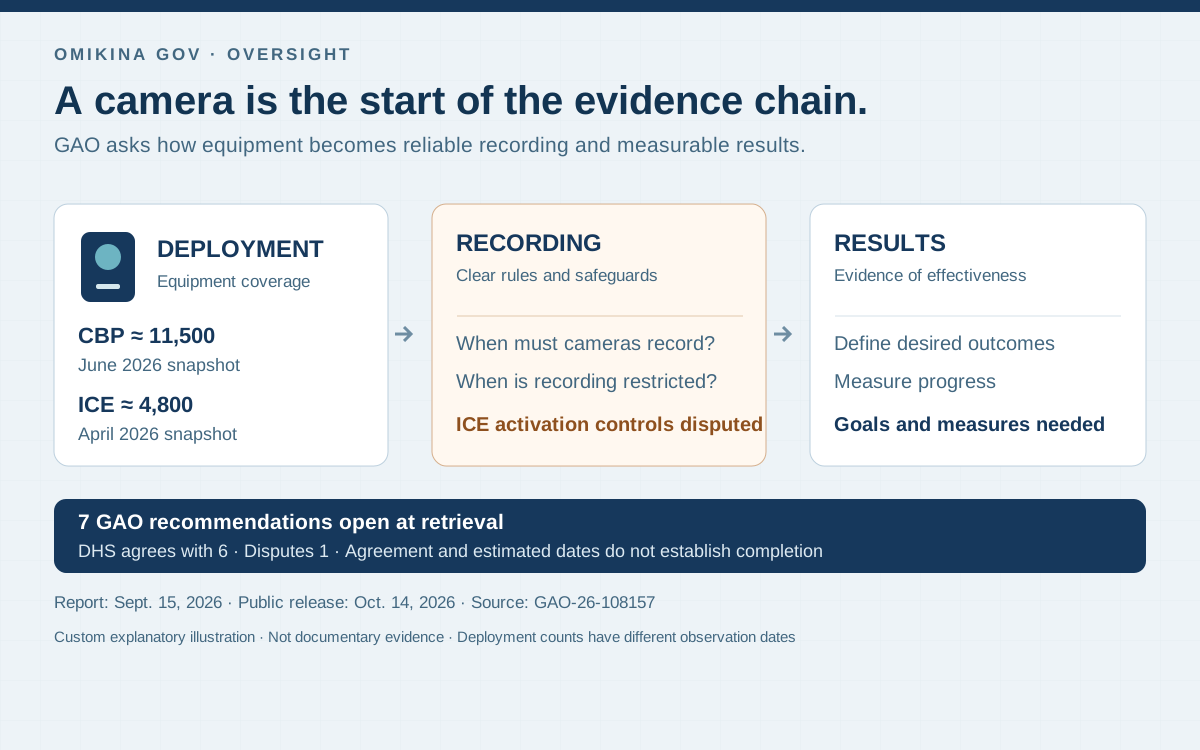
The scale is substantial but the snapshots differ. GAO reports approximately 11,500 CBP cameras deployed as of June 2026, nearly all to Border Patrol, and approximately 4,800 ICE cameras as of April 2026, divided almost evenly between Enforcement and Removal Operations and Homeland Security Investigations. Those counts describe deployment. They do not measure how often required encounters were recorded or whether the programs improved public trust. [2]
Hardware and outcomes answer different questions
Both agencies had initial management plans, but GAO found CBP had not updated its plan since 2022 and ICE since 2024. The plans did not account for significant changes, including increased planned camera deployment and a 2025 pause in further deployment. The finding concerns management of a changing program; this article does not treat the audit’s dated account as proof that the deployment pause remains in effect on October 14. [2]
The agencies track some information about camera availability and reliability, yet GAO found neither had implemented goals and measures that assess desired program results. Our analysis is that a functioning device and an effective accountability program require different evidence. A camera count can establish equipment coverage. To assess effectiveness, oversight also needs defined results, relevant measures and a way to connect those measures to what the program is meant to accomplish. [2]
The disagreement is about recording controls
GAO’s fifth recommendation asks ICE to implement additional controls, such as automated activation, to help ensure recording follows policy. In its August 28 response, DHS disagreed, arguing that existing policy and supervision were sufficient and that automatic activation could create privacy and operational risks, including unintended recording of informants, victims or protected activity. GAO maintained its recommendation, saying the response did not identify environments where automation might work or alternative controls to ensure required activation. [2] [3]
That dispute should be examined as a control-design question, not flattened into a claim that every encounter should automatically be filmed. Both recording failures and unauthorized recording can matter. The useful next evidence would explain where recording is required, where it is restricted, which safeguards address each risk and how compliance is tested. GAO identifies a weakness in assurance; this article does not establish misconduct in any particular encounter. [2] [3]
Agreed actions still need demonstrated completion
GAO made seven recommendations: three to CBP and four to ICE. DHS agreed with six. Its response gives prospective dates, including March 31, 2027 for CBP operational guidance and June 30, 2027 for ICE Homeland Security Investigations guidance. These are estimated completion dates, not completed corrections. At retrieval, GAO’s public page marked all seven recommendations open, including the disputed activation-controls recommendation. [1] [2] [3]
The audit also has an explicit boundary: its six in-person and four virtual site visits covered a nongeneralizable sample of ten locations. Personnel interviewed in six locations expressed uncertainty about activation requirements, but that is not a national prevalence estimate. GAO describes existing supervisory and footage-management controls as well as deficiencies. Follow-up should therefore test the specific recommendations and their supporting evidence, rather than assume the entire program lacks safeguards or that agency agreement has already solved the problems. [2]
The evidence file
Sources & evidence
Read the original records behind this analysis. Dates below distinguish publication from retrieval.
Published September 15, 2026. Retrieved October 14, 2026.
Published September 15, 2026. Retrieved October 14, 2026.
Published August 28, 2026. Retrieved October 14, 2026.
How this article was prepared
AI assisted the research and writing of this original analysis. It is grounded in the linked public sources. Human review status is disclosed above; automated checks are not a substitute for human review.
Editorial standardsCorrections policy