Key findings
- Two October 6 reports became public October 16; their dates and release dates are distinct.
- BLM generally lacks documented citizenship qualification checks for mining claimants.
- Seven unresolved incorporation matches in a targeted 15-claimant sample cannot establish a national noncompliance rate.
- U.S. incorporation and foreign parent-company investment are different questions.
What remains open
- What staff instructions and completed case checks will support closure of GAO’s open recommendation?
- How will policymakers obtain more complete investment information while preserving the distinction from claimant eligibility?
The verified change is public access to two audits
Two GAO reports publicly released October 16 identify separate information gaps in federal hardrock mining: whether claimants meet citizenship requirements and how much foreign investment supports mining on federal land. Both reports are dated October 6. Their public release supplies new inspectable evidence; it does not mean the underlying mining activity or legal requirements began today. [1] [3]
The citizenship audit finds that the Bureau of Land Management generally does not collect citizenship information or document whether mining claimants qualify. Officials told GAO the agency rarely verifies citizenship. Our reading is that this is first an administrative-control finding: the agency lacks information needed to demonstrate compliance with an existing requirement. [2]
Seven unresolved records do not establish seven violations
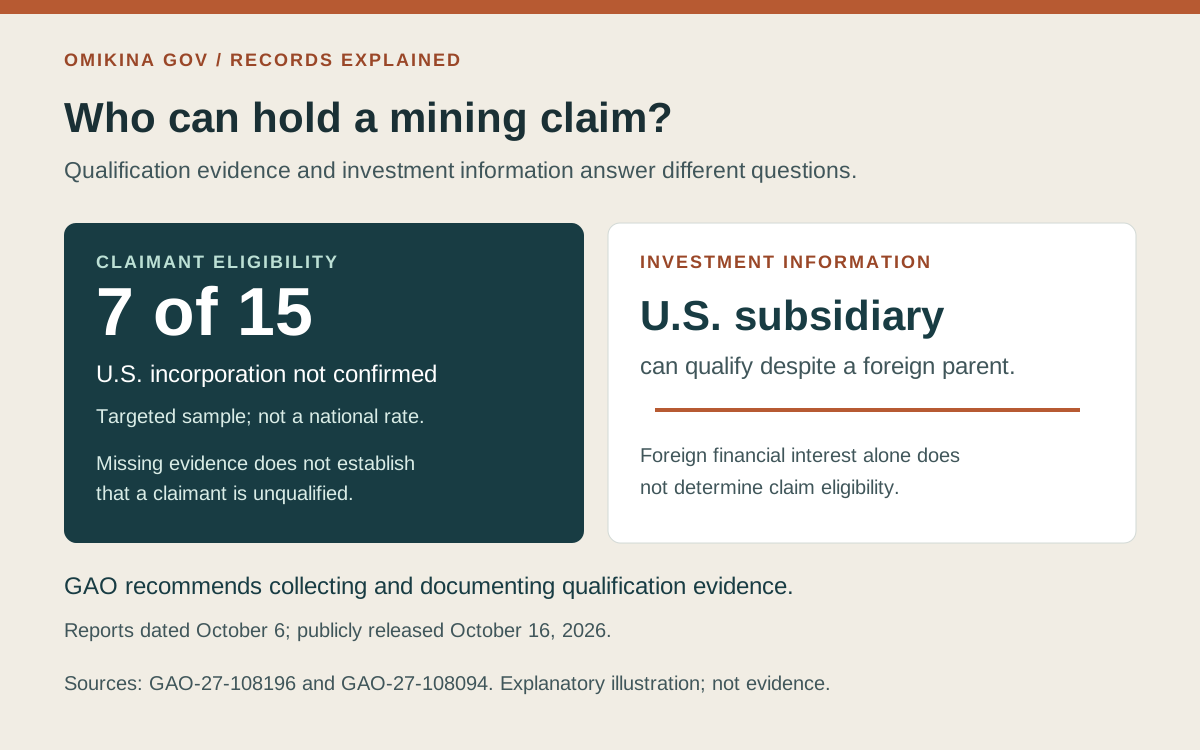
GAO started with 236 claimants that appeared to be business entities and matched 162 to U.S.-incorporated entities in a commercial registry. From the remaining 74, it selected 15 for further review. That targeted, nongeneralizable group included seven matching Canadian incorporation records and eight without a registry match. Additional searches found U.S. incorporation evidence for eight of the 15. [2]
For the remaining seven, GAO could not find evidence of U.S. incorporation, and BLM could not supply confirmation. The report explicitly allows that differences in data entry could explain some unmatched records and that some entities may be incorporated in the United States. An unresolved identity match is not an adjudicated violation. Seven divided by 15 therefore cannot be presented as the share of all claimants breaking the law. [2]
Eligibility and foreign investment answer different questions
Under the rules described by GAO, claimants generally must be U.S. citizens or entities incorporated in a U.S. state or territory; qualifying applicants for citizenship can also hold claims. A foreign company can use a U.S.-incorporated subsidiary as claimant. Claimants are not required to disclose parent-company relationships or foreign investment to BLM. Foreign ownership alone therefore does not show that a claimant fails the incorporation requirement. [2]
The companion report reviewed 43 claimants and operators associated with critical-mineral mines, determined ownership for 32, and found 14 were subsidiaries of foreign entities. None of those 14 had Chinese-owned parent companies, although Chinese entities had financial interests in at least two foreign parents. These are different relationships and different denominators from the 15-claimant citizenship sample. They should not be combined into a count of unlawful foreign-controlled mines. [4]
GAO also distinguishes claimants, who hold mineral rights, from operators, who conduct mining and processing. Its companion report describes other federal authorities, including Treasury-led national-security investment review. Our analysis is that verifying a claimant’s legal eligibility and identifying investment-related risks require separate evidence trails. A corporate charter cannot by itself describe every investor, and a foreign financial interest cannot by itself invalidate a claim. [4] [2]
What would demonstrate a correction
GAO recommends that BLM direct staff to collect citizenship information and document that claimants meet the applicable requirements. The public recommendation record lists that action as open; Interior did not provide comments on the report. The next useful records would show the staff direction, documentation standards and completed checks. A new instruction alone would not establish that existing records were reviewed successfully. [1] [2]
This desk reviewed the original GAO reports and public product records, rather than reperforming GAO’s corporate searches. We have not obtained claimant responses, BLM case files or later implementation evidence. The paired audits justify scrutiny of information collection and verification; they do not establish a national violation rate, a proven financial loss or misconduct by an unnamed company. [2] [4]
The evidence file
Sources & evidence
Read the original records behind this analysis. Dates below distinguish publication from retrieval.
Published October 6, 2026. Retrieved October 16, 2026.
Published October 6, 2026. Retrieved October 16, 2026.
- GAO-27-108094 product record gao.gov
Published October 6, 2026. Retrieved October 16, 2026.
Published October 6, 2026. Retrieved October 16, 2026.
How this article was prepared
AI assisted the research and writing of this original analysis. It is grounded in the linked public sources. Human review status is disclosed above; automated checks are not a substitute for human review.
Editorial standardsCorrections policy