Key findings
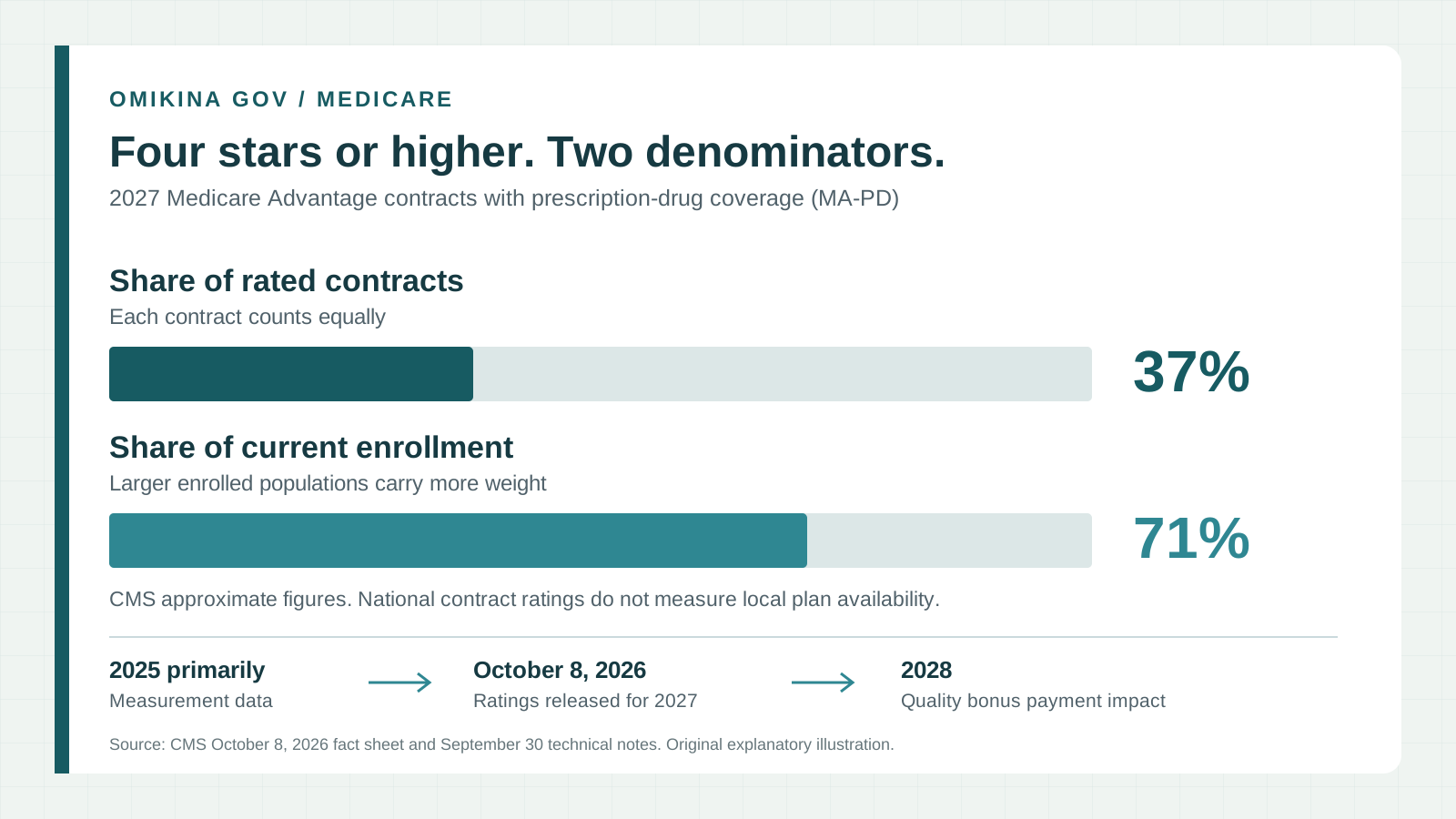
- Approximately 37% of rated MA-PD contracts received four or more stars, representing approximately 71% of current MA-PD enrollment.
- The 2027 contract-year ratings use data primarily from measurement year 2025.
- New measures, changed weights and appeals-data checks complicate simple year-to-year comparisons.
What remains open
- Which individual measures and adjustments explain each contract’s rating change?
- What contract-level records establish the effect of the new appeals-data completeness checks?
The new release changes the public comparison record
The Centers for Medicare & Medicaid Services released its 2027 Medicare Advantage and Part D Star Ratings on October 8, 2026. The ratings appear on Medicare Plan Finder ahead of the October 15–December 7, 2026 enrollment window for 2027 coverage and will affect 2028 Medicare Advantage quality bonus payments. Those are three different dates with different purposes: publication, coverage selection and payment consequences. [1]
The headline figures require another distinction. CMS says approximately 37% of Medicare Advantage contracts with prescription-drug coverage, or MA-PDs, earned at least four stars: 188 of 508 rated contracts in its table. Weighted by enrollment, approximately 71% of current MA-PD enrollees are in contracts with four or more stars for 2027. These figures can coexist because the first counts contracts equally and the second gives larger enrolled populations more influence. [1]
Contract shares are not a local coverage map
Our analysis is that the enrollment-weighted figure answers an exposure question: how much current enrollment sits in higher-rated contracts? The contract share answers a different distribution question: how common are higher ratings among rated contracts? Neither is the percentage of suitable choices available to a particular household. CMS reports these quality data at the contract or sponsor level, and its fact sheet presents ratings alongside benefits and costs rather than as the entire coverage comparison. [1] [2]
The distinction is especially important for standalone prescription-drug plans, or PDPs. CMS reports 11 contracts at four stars or higher, approximately 27% of the 41 rated PDP contracts. Their share of current enrollment is approximately 22%, compared with approximately 2% in the 2026 column. That is a substantial change in the published rating distribution. It does not establish that every enrollee’s drug access, cost or experience improved by a corresponding amount. [1]
The 2027 label does not mean care delivered in 2027
CMS’s technical notes, updated September 30, 2026, explain that the 2027 contract-year ratings use data primarily from measurement year 2025. Individual measures have their own collection periods. For example, breast-cancer screening uses January–December 2025 data, while the physical-health outcome measure draws on a 2023 baseline and 2025 follow-up survey cohort. A forward-facing rating label therefore summarizes earlier evidence; it cannot report future 2027 outcomes. [2]
The measurement framework also changed. Two medication measures enter the ratings: concurrent use of opioids and benzodiazepines, and use of multiple anticholinergic medications in older adults. Each carries a weight of one. The physical- and mental-health outcome measures increase from a weight of one to three. CMS also recalculates measure cut points annually. Comparing overall stars across years without these details can mistake a changed scoring framework for a clean measure of changed care. [1] [2]
Appeals data become part of the accountability test
One methodological change concerns the completeness of appeals records. CMS now uses Part C Reporting Requirements data to check Independent Review Entity data for two measures: timely decisions about appeals and reviewing appeals decisions. The technical notes describe comparing cases that should have been forwarded with submissions received, then applying scaled measure-level reductions when data integrity problems are identified. This makes the reporting trail part of the rating, rather than assuming the available appeals records are complete. [1] [2]
That framework is an accountability mechanism, not evidence from this publication that a particular insurer withheld cases or broke the law. A useful follow-up would connect a contract’s rating change to its individual measure results, the applicable cut points, measurement periods and any recorded adjustments. We have not independently recalculated contract ratings or inspected individual appeals files. The new release supports examining those questions; it does not answer them all. [2]
What the aggregate figures leave open
The next test is whether readers can trace a rating back to the evidence that produced it. CMS’s distributions are useful national summaries, but the contract unit, current-enrollment weighting and earlier measurement periods should remain visible whenever the numbers are reused. This article explains the release and its limits. It does not recommend a plan, establish an individual care outcome or estimate the dollar value of future bonus payments. [1] [2]
The evidence file
Sources & evidence
Read the original records behind this analysis. Dates below distinguish publication from retrieval.
Published October 8, 2026. Retrieved October 8, 2026.
Published September 30, 2026. Retrieved October 8, 2026.
How this article was prepared
AI assisted the research and writing of this original analysis. It is grounded in the linked public sources. Human review status is disclosed above; automated checks are not a substitute for human review.
Editorial standardsCorrections policy