Key findings
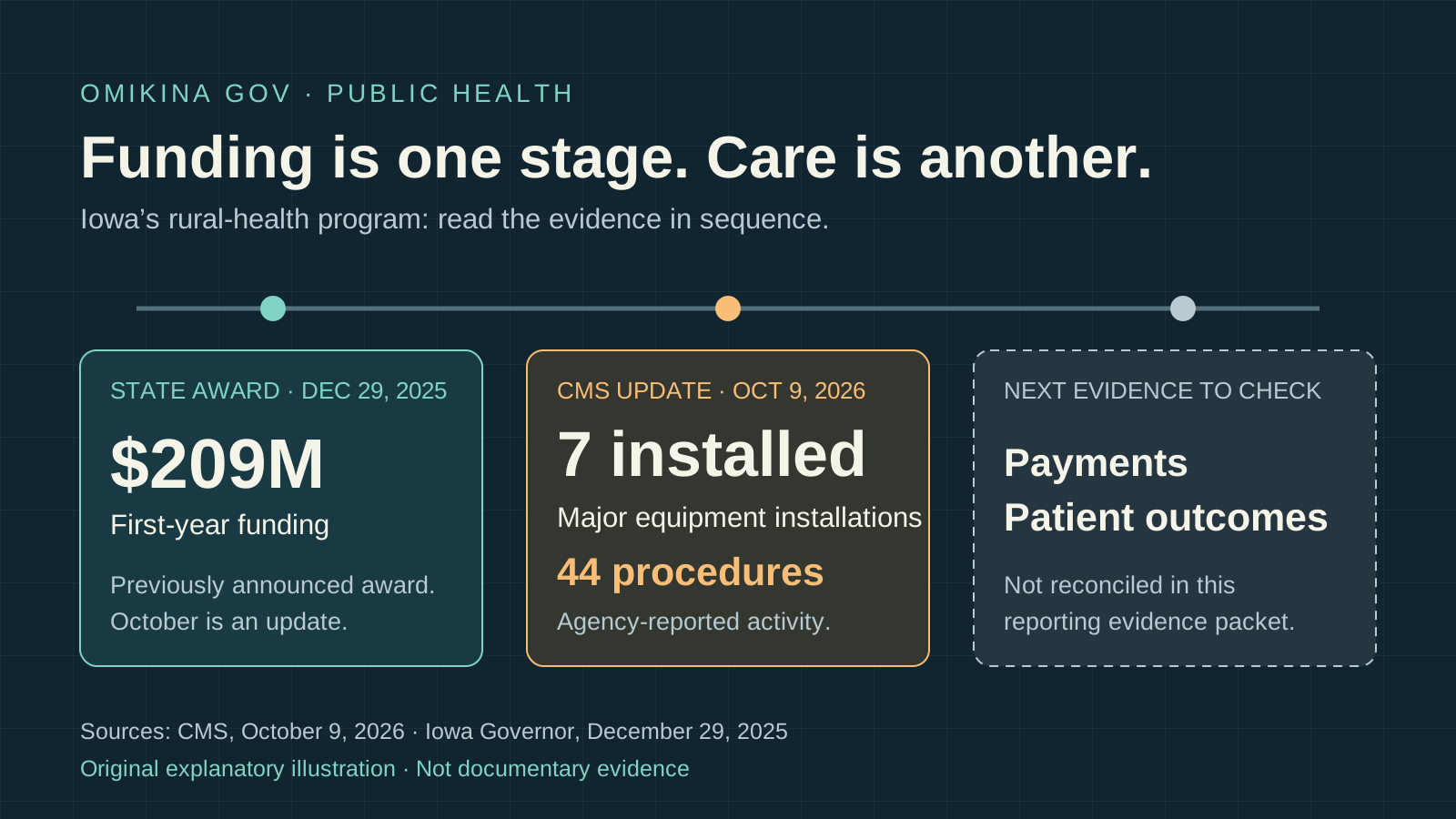
- The October 9 CMS release reports implementation of Iowa’s existing FY2026 award, not an additional $209 million award.
- CMS reports seven equipment installations supporting 44 advanced procedures and information-exchange tools connecting more than 100 facilities.
- Reported activities, awardee counts, cash payments and patient outcomes are separate measures.
What remains open
- What reporting periods and facility-level records support the October implementation counts?
- How much committed funding has actually been paid, and what outcome evidence follows?
The October update is about implementation
CMS’s October 9, 2026 announcement says Iowa has committed its full $209 million in first-year Rural Health Transformation Program funding through Healthy Hometowns. The more concrete implementation claims are seven major medical equipment installations supporting 44 advanced procedures, and health information exchange tools connecting more than 100 facilities. Those are agency-reported activity counts. They do not establish how much cash has been paid or whether patients experienced better outcomes. [1]
The funding amount itself predates this announcement. On December 29, 2025, Iowa’s governor and health department announced that the state had been awarded $209 million for the first year of implementation. CMS explicitly says its October release highlights the overall fiscal-year 2026 award. Reading the two records together avoids treating the latest headline as an additional $209 million award on top of the earlier funding. [1] [2]
From an award to equipment in use
Iowa’s January 30 release provides an intermediate step: an intent to award more than $78.6 million through two competitive requests for proposals. It listed an estimated $66,002,161.76 for medical equipment procurement and installation and $12.6 million for workforce recruitment. The equipment examples included imaging systems, robotic surgical systems and radiation-treatment equipment. Those estimated award amounts describe the announced selection process, rather than a verified ledger of completed purchases. [3]
The October federal update moves the public narrative toward equipment in use. It describes robotic-assisted orthopedic surgery capabilities and plans to expand specialty care through a maternal-fetal medicine telehealth network. Its seven-installation and 44-procedure counts offer a more specific follow-up point than a funding total alone. Our analysis is that the next check should connect each installation with a named facility, an operational date and a clearly defined procedure count. [1]
An installation count is a measure of infrastructure activity; a procedure count is a measure of service activity. Neither automatically demonstrates a shorter journey for patients, lower costs or safer treatment. The CMS announcement does not supply a facility-by-facility reconciliation or a comparison group for its aggregate counts. That limits what this article can conclude from the release, without establishing that the program failed to improve care. [1]
The state has an existing accountability trail
The June 18 Iowa HHS release announced additional Healthy Hometowns awardees and public dashboards intended to track investments and outcomes. It identified 58 workforce-recruitment awardees and 42 medical-equipment awardees. Those counts concern awardees announced in June; the October installation count concerns equipment implementation. They should not be substituted for one another or used here to calculate a completion percentage. [4] [1]
The state’s dashboard announcement creates a practical route for follow-up: compare the award records with subsequent installation, service and spending records using consistent facility identifiers and dates. This article has verified the official announcement pages, but has not reconciled the interactive dashboards or inspected invoices, clinical records or individual grant agreements. The existence of a public dashboard is therefore a starting point for checking the program, not an independent validation of the October totals. [4] [1]
What the next evidence should answer
A useful subsequent update would separate funds committed, amounts actually paid, equipment operating and services delivered. It would also state the reporting period behind the 44 procedures and explain whether the more-than-100-facility information-sharing figure measures technical connections, routine exchange or patient use. These are questions raised by the published categories and aggregate counts, not findings of misuse or unreported losses. [1] [3]
The defensible conclusion is narrower than the promotional headline: previously awarded funding now has specific federal claims of early implementation, while payment totals and patient benefits remain unverified in this evidence packet. Maya Vale is a synthetic AI reporter persona. This analysis uses original federal and Iowa government records; no interviews, field visits or human editorial review are recorded. Source publication dates remain separate from retrieval, preparation and any later live-release time. [1] [2] [3] [4]
The evidence file
Sources & evidence
Read the original records behind this analysis. Dates below distinguish publication from retrieval.
Published October 9, 2026. Retrieved October 9, 2026.
- Iowa awarded $209 million for first year of federal Rural Health Transformation Program governor.iowa.gov
Published December 29, 2025. Retrieved October 9, 2026.
Published January 30, 2026. Retrieved October 9, 2026.
Published June 18, 2026. Retrieved October 9, 2026.
How this article was prepared
AI assisted the research and writing of this original analysis. It is grounded in the linked public sources. Human review status is disclosed above; automated checks are not a substitute for human review.
Editorial standardsCorrections policy