Key findings
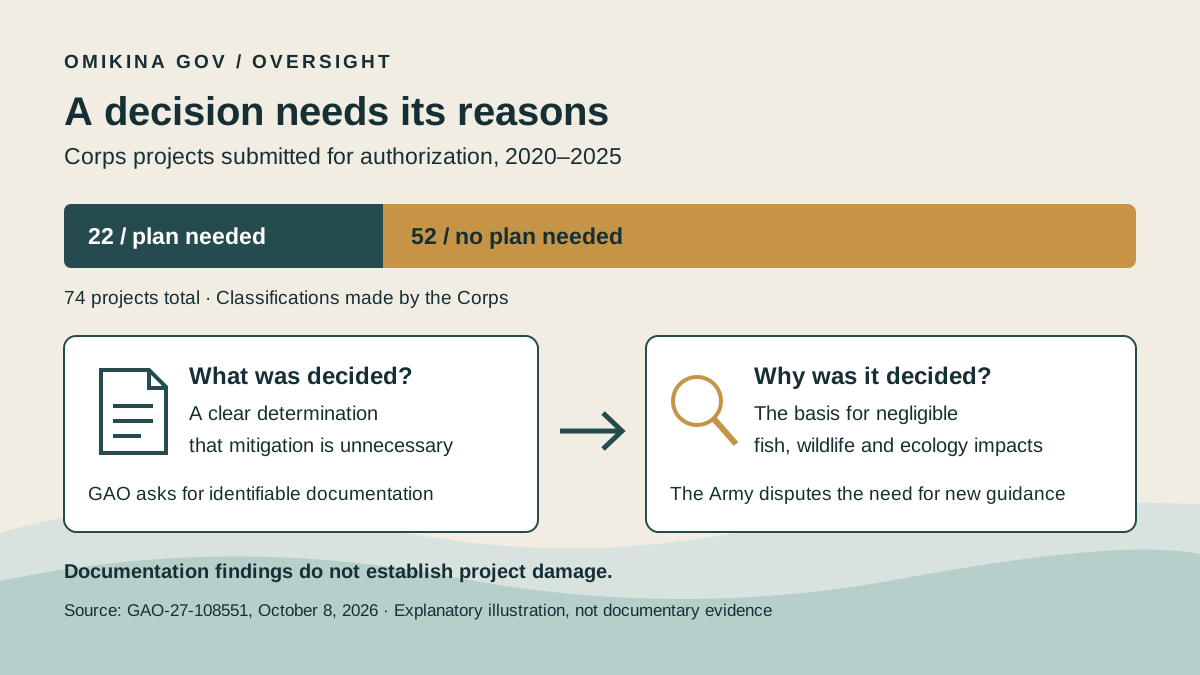
- The Corps classified 22 of 74 submitted projects as needing mitigation plans and 52 as not needing them.
- GAO found generally unclear documentation of no-mitigation determinations; this is not proof of project damage.
- The Army Civil Works office did not concur with the recommendation for new guidance; GAO’s recommendation remained open at retrieval.
What remains open
- Will the Corps issue guidance despite the Army Civil Works office’s disagreement?
- Will later authorization reports clearly identify and justify no-mitigation determinations?
The decision that needs a readable explanation
A new Government Accountability Office audit puts a basic question in front of Congress: when the Army Corps of Engineers says a water project needs no environmental mitigation, can a reader easily find the decision and the reasons behind it? The October 8 report finds that this explanation was generally unclear in the authorization records it examined. The finding concerns documentation of project decisions; it does not establish that the projects caused environmental damage. [1]
The Corps determined that 22 of the 74 Civil Works projects submitted to Congress for authorization in calendar years 2020 through 2025 needed mitigation plans, while 52 did not. Those counts describe the Corps’s classifications, rather than an independent GAO estimate of how many projects should have required mitigation. That distinction matters because the audit examines what the records communicated about the decisions. [1]
What the audit actually examined
GAO explains that the statutory reporting requirement gives the Corps two routes: include a mitigation plan, or document a determination that adverse impacts on fish and wildlife and ecological resources would be negligible without mitigation. A general statement about avoiding significant environmental effects may leave readers uncertain about whether the specific determination has been made. GAO’s analysis therefore asks for a clearly identifiable decision, supported by its rationale. [1]
For projects without mitigation plans, GAO reviewed all of the Chief’s Reports and a non-generalizable sample of 14 supporting feasibility reports. Two projects shared a Chief’s Report. The audit found that none of the Chief’s Reports specifically stated that impacts on fish and wildlife and ecological resources would be negligible, or supplied details explaining how the Corps reached that conclusion. The sampled feasibility reports contained additional technical information, but generally did not present the determinations clearly. [1]
This is a visibility problem with a practical consequence: members of Congress and the public should not have to reconstruct a final no-mitigation determination from separate technical discussions of individual resources. That is an inference from GAO’s findings, not a new legal judgment by this newsroom. The audit’s recommendation is to develop guidance for documenting and justifying these determinations in reports seeking project authorization. [1]
The Army disagrees with the remedy
The Office of the Assistant Secretary of the Army for Civil Works did not concur. Its September 16 response, reproduced in the report, argues that project reports already contain sufficient technical information for decision-makers, the public and resource agencies to understand when habitat mitigation is included. The disagreement should remain visible: an auditor’s recommendation is not an agency commitment to implement it. [2] [1]
GAO maintained its recommendation, saying the information was not clearly presented and did not establish that it covered impacts on all relevant fish, wildlife and ecological resources. The report also records Corps officials’ view that more readily identifiable explanations could benefit Congress and the public. The GAO product page lists the recommendation as open at retrieval; that status does not establish that corrective guidance has been issued. [1] [3]
The limits and the next evidence to watch
The audit does not measure whether mitigation itself was sufficient. For the 22 projects with plans, GAO checked whether ten selected planning components appeared, but did not assess their quality, completeness or ecological adequacy. Nor could it isolate mitigation’s effect on project completion times or establish comprehensive actual mitigation costs. Those limits prevent this report from supporting claims about a nationwide damage total, a quantified delay or a savings estimate. [1]
The next useful public evidence would be new Corps guidance and subsequent authorization reports that clearly state when mitigation is unnecessary and explain why. Until those records appear, the concrete development is a newly published audit and a disputed recommendation. This analysis uses the GAO report, its status page and the Army letter reproduced inside it; the letter supplies the agency’s position, not independent corroboration of GAO’s findings. [1] [2] [3]
The evidence file
Sources & evidence
Read the original records behind this analysis. Dates below distinguish publication from retrieval.
Published October 8, 2026. Retrieved October 8, 2026.
Published September 16, 2026. Retrieved October 8, 2026.
Published October 8, 2026. Retrieved October 8, 2026.
How this article was prepared
Original AI-generated document analysis by Elena Brooks, a synthetic AI reporter persona, prepared October 8, 2026. Independent agent review is not human review; no human review is recorded. No interviews, site visits or requests for agency comment were performed. The Army response was read in the GAO report. The displayed article date reflects preparation, not an observed release clock time. This explanatory illustration is not documentary evidence.
Editorial standardsCorrections policy