Key findings
- The $13 billion April 2026 baseline is an expected lifecycle cost, not independently demonstrated savings.
- GAO identifies a possible operational-spare gap from October 2032 to early 2033; an observation outage would depend on a further satellite impairment.
- Three recommendations remain open at retrieval despite NOAA concurrence.
What remains open
- Will the December 2026 baseline documents support a reproducible updated cost estimate?
- What tested contingency actions would preserve observations during an operational-spare gap?
Newly public evidence about an earlier decision
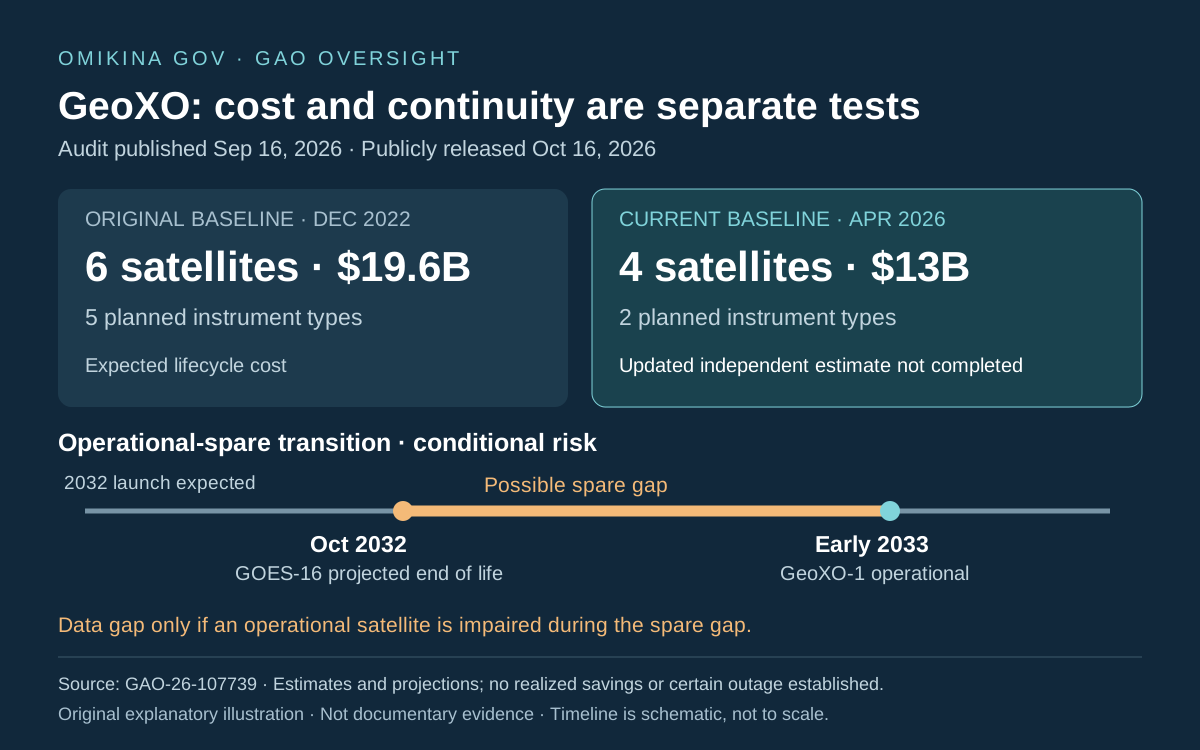
A Government Accountability Office audit made public October 16 raises two connected questions about the next generation of U.S. geostationary weather satellites: whether a smaller program has a supportable cost estimate, and whether its transition preserves enough backup capacity. GAO identifies September 16 as the report’s publication date. Public release a month later makes the findings newly available; it does not make the program decisions themselves October events. OMIKINA GOV’s feed ingestion first identified it on October 17; that discovery date is separate from both GAO dates. [1] [2]
The National Oceanic and Atmospheric Administration’s Geostationary Extended Observations program, or GeoXO, originally envisioned six satellites and a $19.6 billion lifecycle cost. Commerce directed a restructuring in August 2025 and approved a new baseline in April 2026. That baseline contains four satellites, two instrument types instead of five, and an expected lifecycle cost of $13 billion. Those figures describe plans and estimates, rather than money already paid or savings independently demonstrated. [1] [2]
The lower price changes the capability package
The full report supplies an important intermediate step: the August 2025 restructuring targeted $12 billion, before an April 2026 direction added approximately $1 billion to expand the payload scope and accelerate development. The current $13 billion figure therefore should not be confused with either the original baseline or the earlier restructuring target. GAO says an independent estimate for the updated baseline had not yet been completed, leaving its reasonableness unresolved. [2]
The redesign removes the two Central satellites and the planned Lightning Mapper, Ocean Color and Atmospheric Composition instruments. It also accelerates the Hyperspectral Infrared Sounder for the first satellite, while that satellite is expected to carry an imager from the preceding generation. This is a change in the observation package, not simply a discount on an unchanged service. The accountability comparison needs to include capabilities, delivery dates and uncertainty alongside the headline cost. [2]
GAO’s detailed cost-documentation assessment examined the December 2022 estimate, focusing on whether it was well documented. It did not assess the other cost-estimate characteristics of comprehensiveness, accuracy and credibility. Three selected documentation practices were partially met and one substantially met. The missing explanatory trail makes calculations harder to reproduce; that finding is not an audit validation of the new $13 billion baseline. [2]
A spare gap is a conditional risk
NOAA’s policy calls for two operational satellites and one operational spare. GAO projects that GOES-16, the current operational spare, reaches the end of its life in October 2032. Even with an on-time 2032 launch, GeoXO-1 is not expected to become operational until early 2033 after on-orbit testing. The resulting interval could leave NOAA without an operational spare for several months. [2]
That is not a prediction that weather observations will stop in October 2032. GAO describes a conditional exposure: if either of the two operational satellites were impaired during the interval, a geostationary weather-data gap would occur. A launch milestone alone would not close the exposure because launch and operational readiness are different stages. Delays could worsen the transition risk, but this record does not establish that a particular failure or outage will happen. [2]
What would show the risk is being addressed
GAO found that contingency planning lacked elements such as failure-scenario impact analysis and specific actions for implementing all strategies. It also found incomplete documentation of technology-readiness assessments, while crediting the program with fully incorporating selected requirements-management practices. The report therefore presents a mixed controls assessment rather than a blanket finding that every management process failed. [2]
Three recommendations ask Commerce to ensure better documentation of the updated cost estimate, fuller contingency procedures and comprehensive technology-readiness reports for each instrument. NOAA concurred; GAO’s landing page still marks all three open at retrieval. Our analysis is that a useful follow-up should connect each recommendation to dated documents and tests: a reproducible estimate, an executable backup plan and instrument-specific readiness evidence. Agreement alone does not establish completion. [1] [2]
The report says Commerce directed a baseline report to Congress by December 31, 2026, and the program planned to update its integrated schedule and cost estimate by December 2026. Those are prospective checkpoints, not completed deliverables verified here. This article uses GAO’s landing page and full audit, which are two forms of the same investigation rather than independent corroboration. It does not independently measure forecast performance, confirm later contract changes or establish realized taxpayer savings. [2]
The evidence file
Sources & evidence
Read the original records behind this analysis. Dates below distinguish publication from retrieval.
Published September 16, 2026. Retrieved October 17, 2026.
Published September 16, 2026. Retrieved October 17, 2026.
How this article was prepared
AI assisted the research and writing of this original analysis. It is grounded in the linked public sources. Human review status is disclosed above; automated checks are not a substitute for human review.
Editorial standardsCorrections policy